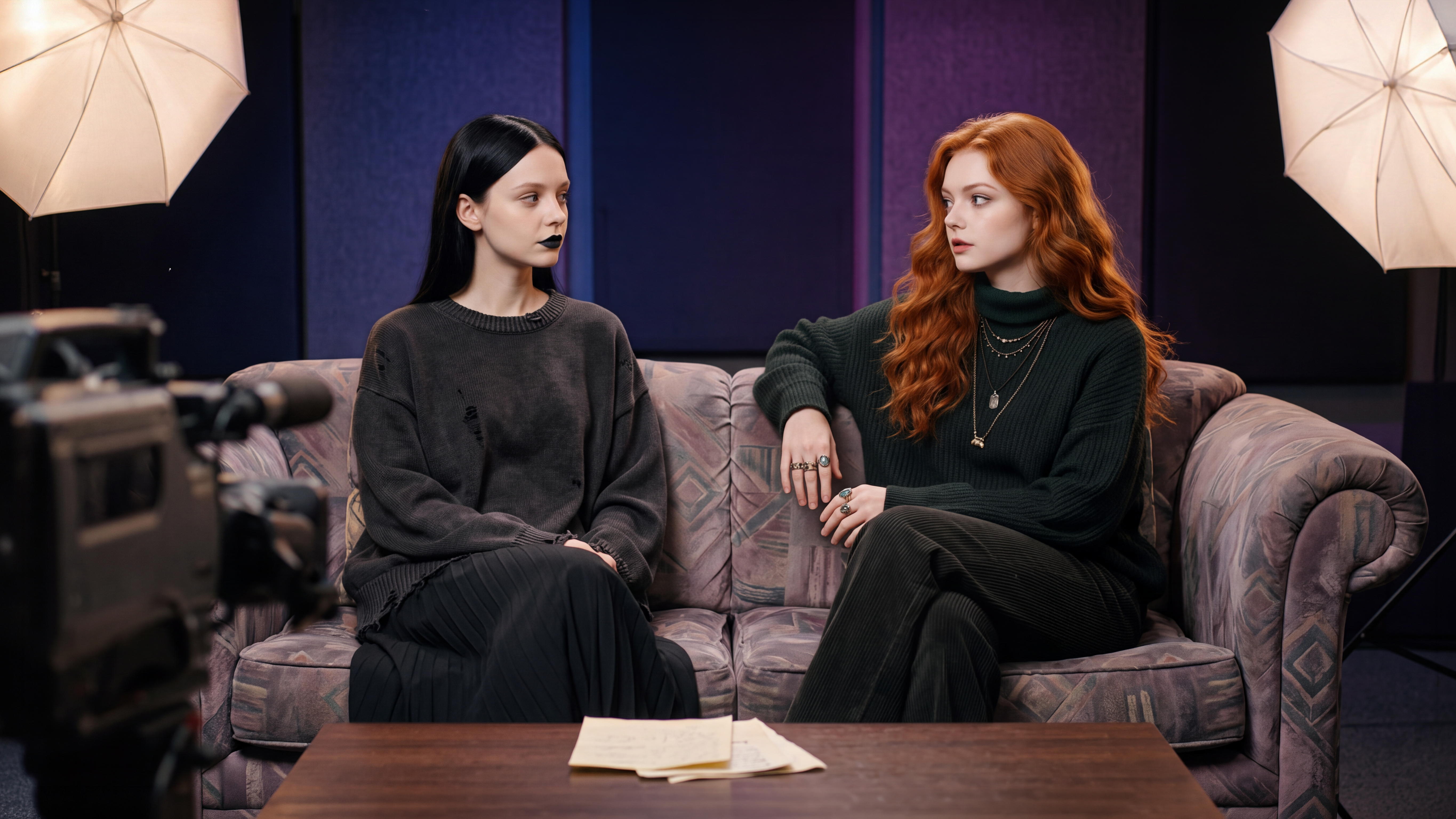

Demitra Kalnina - Interview Photo - September 26, 2026
On Twentynine Palms, Demitra Kalnina, 32, explores the lingering effects of family trauma, the uneasy relationship between spectators and suffering, and a lifelong attraction to the darker corners of film, true crime, and media culture. Across songs such as "Martyrs," "Come & See Us," "Crime Scene," and "Irreversibly Myself," the album asks difficult questions about what draws people toward disturbing stories and what remains after the credits roll.
Q: Twentynine Palms feels deeply personal, but it also spends a lot of time examining humanity's fascination with tragedy. When did those subjects become connected for you?
KALNINA: Probably when I realised the stories I was obsessing over weren't actually separate from my life. As a kid I believed there were two different things happening. There was my family, my memories, the things that frightened me. Then there were the documentaries, the horror films, the news stories, and the strange little corners of the internet I kept wandering into.
Eventually I noticed they were asking the same questions. Why do people hurt each other? What happens afterwards? Does suffering mean anything? I think people assume the attraction comes first. That someone discovers dark media and becomes interested in darkness. For me it was the opposite. I recognised something familiar in it. I wasn't seeking darkness. I already knew where it lived.
Q: New French Extremity films seem like a major influence on the record. What continues to draw you to them?
KALNINA: The reputation is always about shock. The reality is that the best of those films are heartbreakingly sincere. They're trying to claw their way through subjects most people politely avoid. Grief. Mortality. Trauma. Meaninglessness. Whether there's anything waiting beyond suffering. Whether suffering itself changes us. I think that's why Martyrs remains such an important film to me. What interests me is the desperation underneath it. The need for answers. The belief that if we destroy ourselves enough we might finally understand something. That's a very human impulse, honestly. Terrible, but human.
Q: Several songs suggest that darkness wasn't something you chose but something you inherited. How much of this album is about your upbringing?
KALNINA: Most of it. Not in a documentary sense. I'm not interested in recreating events exactly as they happened. Memory doesn't work that way anyway. It rearranges furniture. It changes the wallpaper. It leaves certain rooms locked forever. What I'm interested in is the emotional weather that follows people through their lives. You survive something. Years pass. Then one day you're standing in a supermarket, completely safe, and your body decides it's still back there. That's the inheritance.
Q: "Come & See Us" is one of the album's most confronting songs. What were you trying to say about true crime and tragic media?
KALNINA: I'm not pretending I'm above it. That would be dishonest. I've watched the documentaries. I've followed cases. I've read things most people would rather avoid. The song came from recognising that contradiction. On one hand, curiosity is natural. On the other hand, every tragedy that becomes content belonged to somebody. Somebody's mother. Somebody's brother. Somebody's worst day. What interests me isn't whether people are curious. We always will be. What interests me is whether we remember the humanity underneath the spectacle.
Q: Guilt shows up repeatedly throughout the album. Did you consciously write about that?
KALNINA: I don't think I had to. Guilt writes itself. There are moments on the record where the narrator is looking directly at something awful and asking herself why she can't stop looking. I think a lot of people understand that feeling. Part of you knows better. Part of you keeps returning anyway.
Q: Songs like "Odd Girl" and "Maladjusted" feel almost proudly uncomfortable with social norms.
KALNINA: I've spent enough time being called strange that eventually it became decorative. You stop fighting the label. You hang it on the wall. There's a tendency to assume unusual interests indicate dangerous intentions or moral failure. I don't agree. Curiosity isn't a crime. Being different isn't a crime. Sometimes you're simply the person who asks questions nobody else wants to ask. Sometimes you're the only one staring at the stain everyone else stepped around years ago.
Q: The album doesn't seem especially interested in healing. It feels more interested in coexistence.
KALNINA: Because that's been my experience. The language surrounding healing can become very tidy. Very marketable. You suffered. You learned. You grew. The End. Real life is usually messier than that. The past doesn't disappear. It changes shape. You learn where to place the chair. You learn how to live beside it. That's closer to what this album is exploring.
Q: Film imagery appears everywhere throughout Twentynine Palms. Do you think visually when you write?
KALNINA: Always. Most songs begin as a room. A bus stop. A body standing somewhere alone. The music arrives later. I don't think in melodies first. I think in images and atmosphere. Honestly, if somebody adapted this record into a film it'd probably look like a half-remembered nightmare playing on an old television at three in the morning.
Q: Despite everything we've discussed, the record is surprisingly funny at times.
KALNINA: Because otherwise it would be unbearable. Humour is one of humanity's greatest survival tools. Sometimes all that's left is laughing at the absurdity of the situation. You're alive. You're haunted. You're carrying thirty two years of strange memories. And you're standing in a kitchen eating toast. There is something funny about that. Not optimistic. But funny.
Q: After listeners reach the end of Twentynine Palms, what do you hope remains with them?
KALNINA: A little discomfort. A little recognition. Maybe a feeling that they're not the only person who's spent time staring into subjects they couldn't fully explain. I don't want people to leave with answers. The album doesn't really believe in answers. I hope they leave with compassion. For themselves. For other people. For the strange ways we adapt to things we were never meant to survive. And maybe I hope they leave with one more thought. Not everybody who walks in the dark is lost. Some of us just grew up there.
For listeners preparing to step into Demitra's world, don't expect reassurance. Don't expect closure. Expect flickering fluorescent lights, empty highways, abandoned rooms, old films, unanswered questions, and the strange comfort of finding someone else staring into the dark alongside you.
Per her own words, Twentynine Palms is not an album about escaping the shadows. It's about learning how to recognise your own reflection in them.